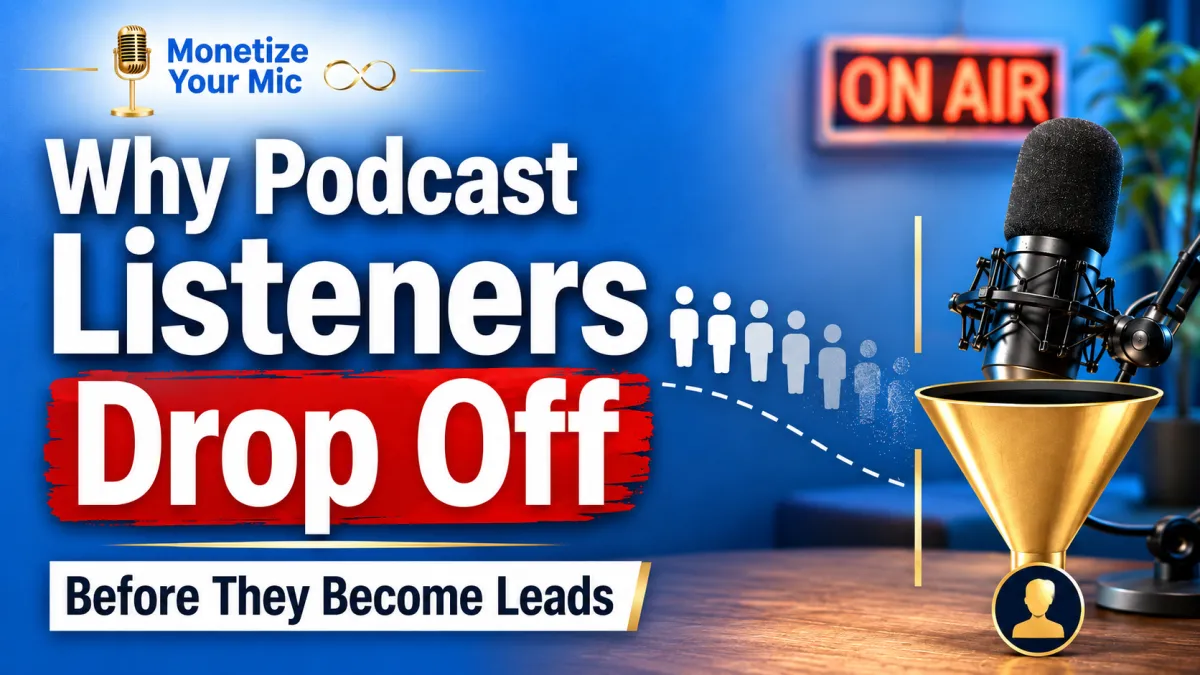
Why Podcast Listeners Drop Off Before They Become Leads
Why Podcast Listeners Drop Off Before They Become Leads
Your podcast episode may be doing exactly what it is supposed to do.
It creates interest. It builds trust. It positions you as someone worth paying attention to.
Then the listener finishes the episode, goes back to their day, and disappears.
That is where most podcast ROI quietly leaks out.
The problem is usually not the episode. It is what happens after the episode. If there is no clear next step, no simple capture point, and no follow-up path, even interested listeners rarely turn into leads.
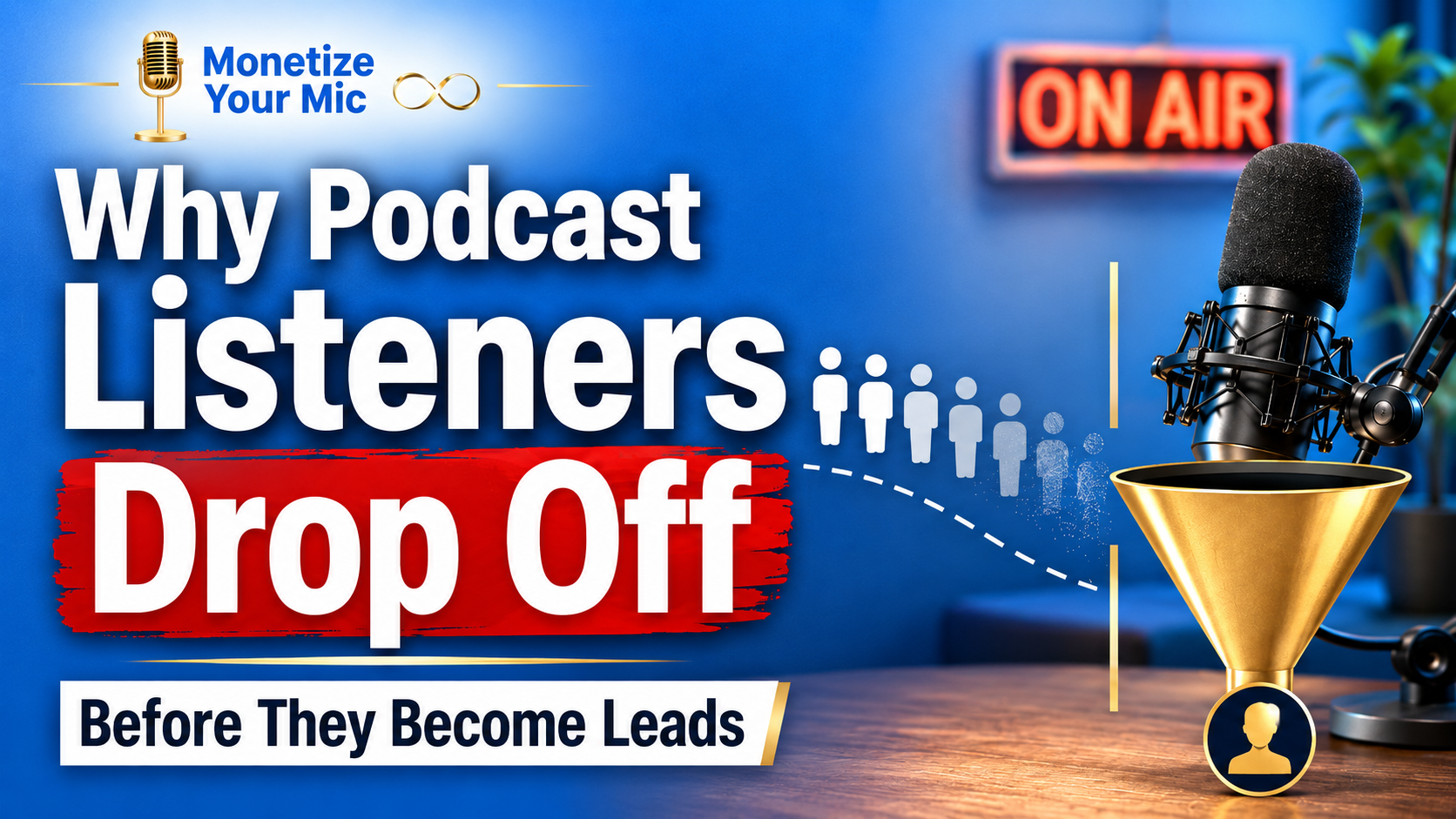
Why showing up on podcasts is not enough
Being a strong podcast guest can create visibility, credibility, and connection, but visibility alone does not create measurable podcast ROI.
A listener may love what you said. They may even think, “I need help with this.” But if the next step is vague, hard to find, or too much of a leap, they will move on.
Most podcast guests assume interest automatically becomes action. It does not.
Interest has a short shelf life. The listener is often walking, driving, working, folding laundry, or half-listening between meetings. They are not sitting at a desk with your website open, ready to hunt down your offer.
That means your podcast guest strategy needs to account for real human behavior.
A listener needs to know what to do next while the moment is still warm. They need a reason to act that feels relevant to the conversation they just heard. And they need a path that does not require too much thinking.
Without that, your episode becomes another good conversation that never turns into a lead.
The drop-off happens after the listener hears you
The conversion gap happens in the space between “that was valuable” and “I am ready to take the next step.”
This is where many podcast guests lose the opportunity they just earned.
The listener hears your story, your insight, or your framework. They feel a spark of recognition. Maybe they realize they have the same problem you described. Maybe they are curious about your process. Maybe they want to learn more.
Then they wait for a clear invitation.
Instead, they often hear something like, “Visit my website,” “Connect with me on LinkedIn,” or “Check out my book.”
Those are not bad links. They are just not always strong conversion steps.
A general website gives the listener too many choices. A LinkedIn connection request depends on whether they remember your name later. A book may build authority, but it may not capture the lead right now.
The listener needs a focused next step tied directly to the problem discussed in the episode.
That is how podcast lead generation starts to become measurable.
Listeners disappear when the next step is unclear
A confused listener does not become a lead.
They may not feel confused in an obvious way. They simply do not know which action matters most.
Should they book a call? Download a guide? Follow you? Join your list? Watch a training? Take an assessment? Read your blog?
When everything is presented as an option, nothing feels like the obvious next move.
This is especially true for podcast listeners because they are usually not in a high-commitment environment. They are consuming the episode while doing something else. The more mental work you create, the more likely they are to delay.
And delayed action often becomes no action.
A strong podcast call to action is not just clear. It is contextual.
It connects to the exact issue discussed in the episode. It gives the listener one simple action. It helps them see why that action matters now.
For example, if the conversation is about turning podcast visibility into revenue, a natural next step is not “go look around my website.” A stronger next step is to invite them to identify where their current podcast ROI is leaking.
That is specific. That is relevant. That gives the listener a reason to move.
A simple capture point changes the whole outcome
A capture point is the place where interest becomes trackable.
Without it, you may be building authority, but you are not building a pipeline.
A good capture point does not need to be complicated. It can be an assessment, short diagnostic, resource, calculator, private training, or focused checklist. The key is that it must connect directly to the listener’s problem.
The best capture points do three things.
They help the listener understand their situation.
They give them a quick win or useful insight.
They create a bridge into the bigger solution you provide.
For podcast monetization, this matters because listeners do not always know what is missing. They may think they need more interviews, better placements, or a bigger following. But often the real issue is that they have no structured way to capture, nurture, and convert the attention they already earned.
A good capture point helps them see that.
It turns the episode from a standalone visibility moment into the front door of a podcast sales funnel.
Follow-up is where podcast ROI becomes real
The follow-up path is what turns a captured listener into a real business opportunity.
This is where most podcast guests leave too much to chance.
Someone listens. They click. They opt in. Then what?
If the answer is “they get added to my newsletter,” that may not be enough.
A listener who came from a podcast episode is already warmed up around a specific idea. The follow-up should continue that conversation, not dump them into a generic email list.
The first few follow-up messages should help them connect the dots.
What problem did the episode reveal?
Why does it matter?
What happens if they keep showing up without a system behind the visibility?
What should they fix first?
What is the next reasonable step if they want help?
This does not need to feel pushy. In fact, the best follow-up often feels like thoughtful continuation. It gives the listener more clarity and helps them decide whether they are a fit.
Podcast ROI improves when the system respects the buyer’s pace while still giving them a clear path forward.
What a working podcast conversion path looks like
A working podcast conversion path has three simple parts: capture, nurture, and convert.
Capture means the listener has one clear place to go after hearing you. It is not buried on your homepage. It is not one of seven options. It is the next step that matches the episode topic.
Nurture means the listener receives helpful, relevant follow-up that builds trust and keeps the problem in focus. It should not feel like a random newsletter sequence. It should feel connected to the reason they raised their hand.
Convert means there is a clear invitation to take the next step when the listener is ready. That may be a demo, strategy call, consultation, or offer conversation.
This is the infrastructure that turns podcast guesting from exposure into a measurable lead generation strategy.
Without it, you are relying on memory, timing, and luck.
With it, every episode has the potential to keep working after the recording ends.
FAQ: Why podcast listeners drop off before becoming leads
Why are podcast listeners not turning into leads?
Podcast listeners often do not become leads because there is no clear next step after the episode. Interest is created during the conversation, but without a focused capture point and follow-up path, that interest fades before action happens.
What is the best CTA for podcast guesting?
The best podcast CTA is specific, simple, and tied to the topic of the episode. Instead of sending listeners to a general website, send them to a focused resource, assessment, or diagnostic that helps them solve or understand the problem discussed.
How do I improve podcast ROI?
To improve podcast ROI, connect every appearance to a system that captures listener interest, nurtures the relationship, and converts qualified prospects into calls or opportunities. The episode builds trust, but the follow-up system turns that trust into revenue potential.
Ready to find your podcast ROI leak?
Your podcast appearances should not disappear into the content graveyard.
If you are showing up on shows, sharing value, and still not seeing leads come from it, the problem may not be your message. It may be the missing path after the episode.
Take the Podcast ROI Reality Check and see where your current podcast guest strategy is leaking opportunity.
Start here: https://profitboosterpod.com
About the Author

Marcia Riner is a Business Growth Strategist and CEO of Infinite Profit®. She works with established business owners as a Growth Implementation Partner, helping them turn strategy into action that drives profitable growth. Through her Profit Booster® frameworks and the Profit Booster® Growth Agency, she helps companies strengthen revenue, improve margins, and build businesses that can scale without the owner carrying everything.
Marcia is also the host of the Profit With A Plan podcast, where she interviews founders, experts, and industry leaders about the real strategies behind business growth, leadership, and building a company with long-term value.
Learn more at https://infinite-profit.com.