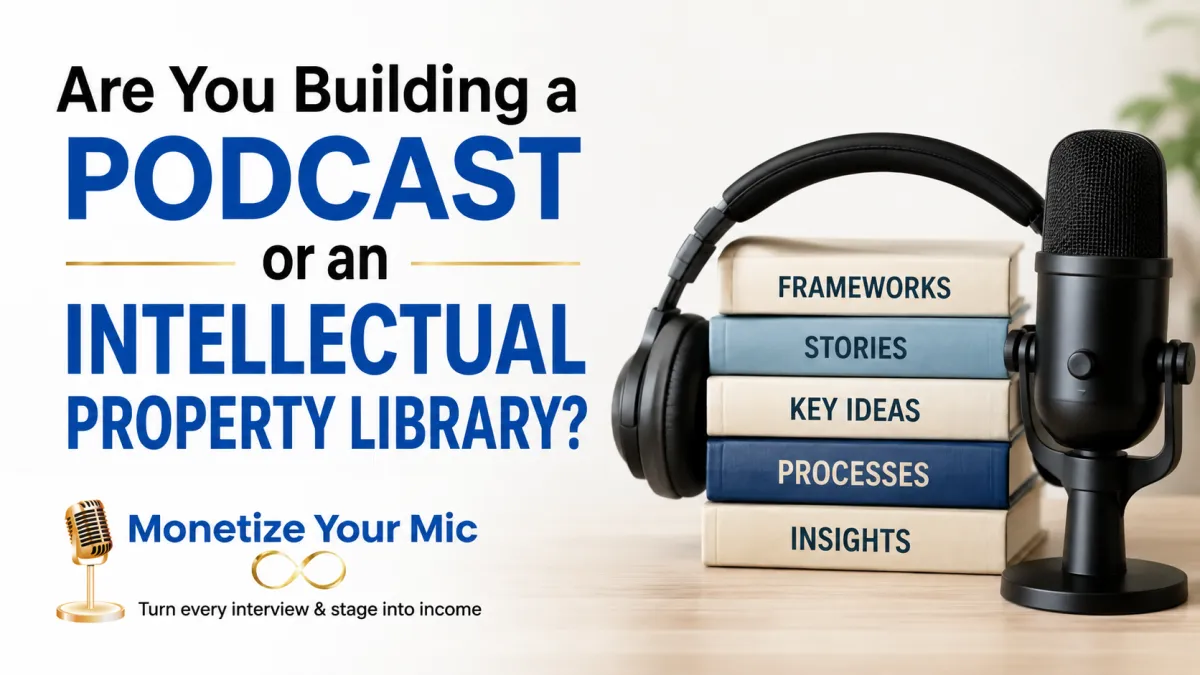
Are You Building a Podcast or an Intellectual Property Library?
Are You Building a Podcast or an Intellectual Property Library?
Most podcasters think about their episodes as content.
Record it. Publish it. Promote it. Move on to the next one.
But after dozens, or even hundreds, of conversations, you may be sitting on something much more valuable than a collection of podcast episodes.
You may be building an intellectual property library.

Every time you explain an idea, tell a story, challenge a common assumption, answer a recurring question, or introduce a framework, you are creating material that could eventually become a workshop, keynote, book, training program, consulting methodology, or signature piece of content.
The problem is that most podcasters never stop long enough to recognize what they have created.
Your Best Ideas Usually Repeat for a Reason
Listen to several of your own podcast episodes and you will probably notice something.
Certain ideas keep showing up.
You may tell the same client story in different ways. You may explain the same three-step process to multiple guests. You may find yourself correcting the same misconception over and over again.
That repetition is not necessarily a sign that you are running out of things to say.
It may be a sign that you have found your intellectual property.
The concepts you naturally return to are often connected to your strongest expertise, your point of view, and the problems your market repeatedly needs help solving.
Those patterns are worth paying attention to.
A Podcast Gives You a Testing Ground for Your Ideas
One of the advantages of podcasting is that you get to develop your thinking out loud.
You explain an idea one week.
A guest challenges it the next.
A listener asks a question that makes you refine it.
A few months later, the idea is sharper, easier to explain, and supported by better examples.
That is exactly how strong intellectual property often develops.
You are not sitting alone trying to invent a perfect framework from scratch. You are testing language, stories, examples, and ideas through real conversations.
Your podcast archive becomes a record of how your thinking has evolved.
Look for the Ideas That Have Legs
Not every podcast conversation needs to become something bigger.
The opportunity is in finding the ideas that keep proving useful.
Start looking through your episode archive for:
Questions you answer repeatedly
Frameworks or processes you explain often
Stories that consistently help make a point
Opinions that clearly differentiate your approach
Problems guests and listeners keep bringing up
Phrases or concepts people remember and repeat back to you
Those are signals.
A five-minute explanation buried inside Episode 87 may eventually become the backbone of a 45-minute keynote.
Three related conversations might become a workshop.
A recurring framework could become a downloadable guide, training series, or client methodology.
Ten episodes around the same business problem could become the rough outline for a book.
The raw material may already exist.
Stop Treating Every Episode Like an Island
This is where many podcasts lose long-term business value.
Each episode gets treated as its own individual piece of content.
There is rarely a system for asking, "What did we create here that can be used again?"
That question changes how you look at podcast ROI.
An episode does not have to generate a client immediately to create value. It may strengthen an idea that later becomes part of a sales conversation, course, presentation, workshop, consulting framework, or book.
But that value is much harder to capture when nobody is tracking it.
Your podcast should not just have an episode archive.
It should have an idea archive.
Build an IP Habit Into Your Podcast Process
You do not need a complicated content management system to start.
After each interview or solo episode, capture a few simple notes.
What idea did I explain particularly well?
Did a new framework or phrase emerge?
What question came up that I should explore again?
Was there a story or example worth saving?
Could any part of this conversation support a future presentation, product, training, article, or offer?
Over time, these notes begin connecting.
Instead of staring at a blank page when it is time to create your next workshop or keynote, you are pulling from ideas you have already tested in the marketplace.
That is a very different way to use a podcast.
Your Microphone May Be Building More Than an Audience
Podcasting is often discussed as a visibility tool.
It can certainly do that.
But the bigger opportunity may be what you are creating while everyone is focused on downloads, clips, and follower counts.
Your conversations are documenting your expertise.
Your stories are becoming teaching tools.
Your repeated ideas are becoming frameworks.
And your archive may quietly be turning into one of the most valuable intellectual property libraries in your business.
The question is whether you are capturing it and connecting it to actual business opportunities.
If you are not sure where your podcast is creating value, or where potential opportunities are slipping through the cracks, take the Podcast ROI Scorecard.
It will help you see what is working, what is missing, and where your podcast could be doing more for your business.
Take the Podcast ROI Scorecard: https://profitboosterpod.com
About the Author

Marcia Riner is the go-to guru for all things business growth and greater profitability. With over 25 years of experience under her belt, she's the brains behind Infinite Profit®, where she's the CEO and business growth strategist. Her Profit Booster® methodology is the secret weapon for entrepreneurs hungry for more profit, growth, and a killer exit strategy that helps businesses outperform in today's challenging market.
Marcia hosts a weekly podcast called Profit With A Plan with videos on YouTube @ www.Youtube.com/profitwithaplan and audio @ www.profitwithaplan.com. She is constantly sharing business growth tips on all of her social channels @marciariner. You can also find her other blogs @ www.infinite-profit.com/blogs